
- Home
- > Craftsman we recommend
- > Keizuka

What is Lacquer
The main ingredient of lacquer is an Urushiol and a good lacquer contains a lot of Urushiol.
To dry lacquer in good condition humidity and appropriate temperature is required, not as same as laundry drying.
( humidity 75% to 85% and temperature 25 to 30 degrees centigrade)
Once a lacquer products were dried, an adhesive power will be generated and never effected with acid, alkali, salt, alcohol and etc. Waterproofing and corrosion are also proven so since an ancient period, people in Japan used a lacquer as a glue and found lacquerwares from many old remains in Japan.
Scratching Urushi
The gathering lacquer season is begriming of June to October in every year which a lacquer tree grow up well in this season. By using a sickle named Kaki Kama, a big scratch is made to around 14 to 15 years lacquer trees. This is called Medachi. Medachi also has a meaning to give a stimulation to lacquer tree then makes tap secretion to lacquer tree. After a fixed period of time, an another big scratchis marked on Medachi and looks like striped pattern to all trucks. A seeped sap is collected by a spatula (Kaki Hera) and stores it little by little to Urushi pod.
The works of scratching Urushi is required high skill. Gathering Urushi sap is only 60g to 200g from one tree. The quality of Urushi will depend on the skill and know-how of scratching workman so KEIZUKA Craft keeps skilled workmen in their firm.
Gathered Urushi sap is stirred then heated and purified. The refined Urushi can be an only expensive Urushi material for Wajima Nuri as Suki Urushi and Kurome Urushi.
WAJIMA URUSHI (Lacquerware)
Wajima is located at the tip of the Noto Peninsula, which juts out into the Sea of Japan. It long acted as a key junction in maritime trade, as a result of which Wajima lacquerware became known around the country.
There are various explanations as to the origins of Wajima lacquerware. One account has it that in the mid-Muromachi Period (around 1400) a Buddhist priest from Negoroji Temple in Kishū (present-day Wakayama Prefecture) came to Jūrenji Temple in Wajima and passed on the knowledge of lacquer techniques. Another theory suggests that a Wajima local called Fukuzō went to Negoro to learn these techniques. Yet another tale handed down over the years says that after the fires caused by Hideyoshi Toyotomi’s 1585 siege of Negoroji, its priests were scattered around the country and they introduced these techniques to places such as Wajima. Whatever the case might be, it is believed that the techniques of Negoro lacquerware, which is the oldest lacquerware used for everyday purposes, were combined with the longstanding lacquerware techniques in Wajima.
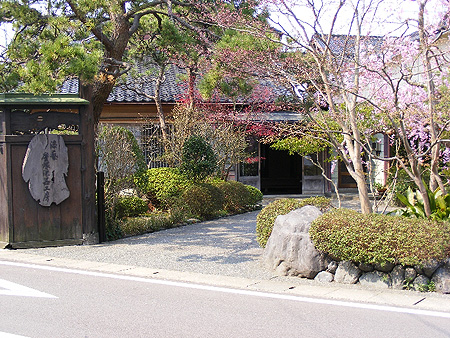
Today the Keizuka Lacquerware Studio is the leading producer of Wajima lacquerware. It started out in 1918 when first-generation owner Shūichi Keizuka, a maki-e craftsman, decided to switch to lacquerer (covering the entire process from production to marketing), with the goal of producing his ideal lacquerware. His determination and pride in his work are evident in the family crest he devised, consisting of a circle around the number one—a symbol of his desire to create the best lacquerware in Japan.
After he passed away, the second generation in the family business, Shūhei Keizuka, faithfully carried on his father’s wishes, devoting himself to perfecting the techniques. He brought together craftsmen (wood artisans, lacquerers, decorative artists, gold inlay artists) renowned for their expertise, and by integrating their skills he successfully created the ultimate in lacquerware.
process
The lacquer process involves over 70 different steps—sometimes up to 120, depending on the particular piece. The key steps are as follows:
As a result of the unstinting efforts and time lavished on top-quality materials, along with the artisans’ finely honed expertise and pride in their work, Keizuka lacquerware embodies a robustness and beauty that will last until one’s grandchildren’s time.
The Keizuka Lacquerware Studio marks all its works with the name “Wajima Keizuka”, taking full responsibility for their production. This spirit has been handed down intact to the current representative of the third generation, Dai Keizuka.
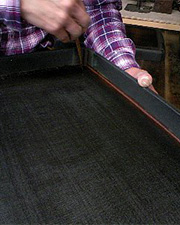
- Making the wooden base
To avoid warping, the wood that forms the base is dried in a chamber and then left to cure naturally for a year. Using techniques befitting the intended use of the specific item, a wood artisan then crafts the base. - Covering the base with linen
Fragile parts are reinforced by pasting linen onto the base using lacquer. - Applying the foundation layers of lacquer
Baked diatomaceous earth is ground into a clay powder that is then mixed with lacquer. This is applied to the wooden base in repeated layers. - Polishing
After the application of each foundation layer, a hard whetstone is used to polish the surface. From the middle coating stage onward, polishing is carried out using a charcoal and water paste. - Final application using high-quality refined lacquer
Dust and other foreign particles mar the finish, so the final application of lacquer is carried out with great care in a special room where the temperature and humidity are maintained at a constant level. - Decoration
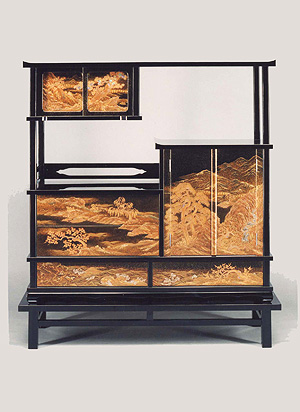
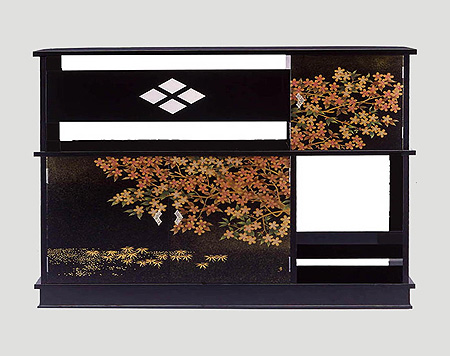
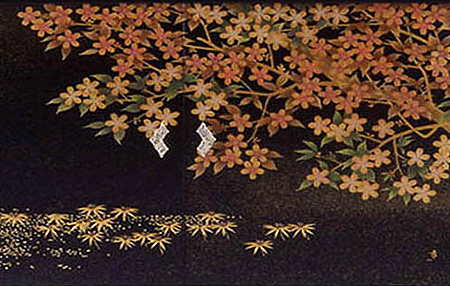
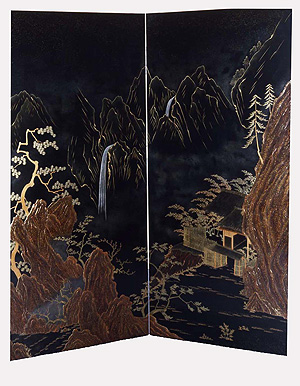
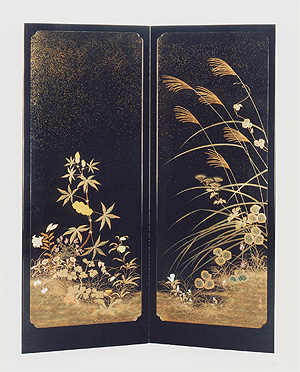
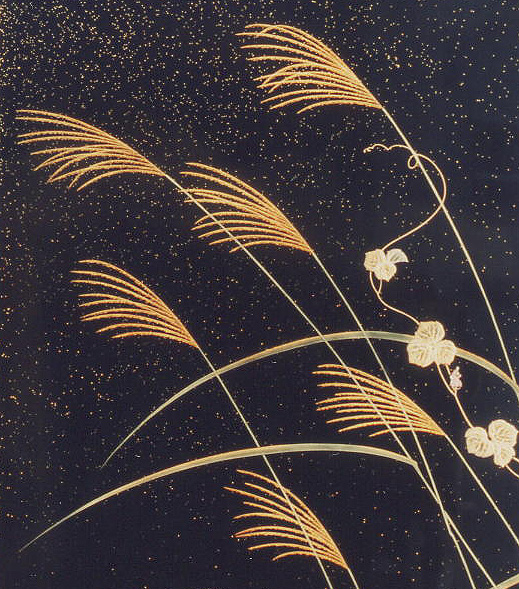
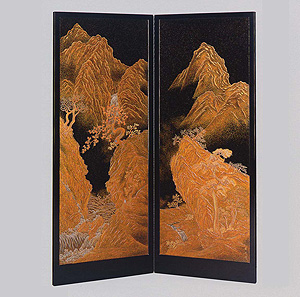
The two artwork methods used with lacquerware are maki-e and chinkin. Maki-e involves applying lacquer to a brush, drawing a design on the surface and sprinkling gold or silver powder on it. Once it has hardened, lacquer is applied, and after the lacquer has dried the design is polished. Chinkin involves etching lines and dots onto the surface then rubbing in lacquer before inlaying gold leaf and gold powder into the grooves.
Images of his works
 |
 |
 |
 |
 |
 |
 |
 |
 |
 |